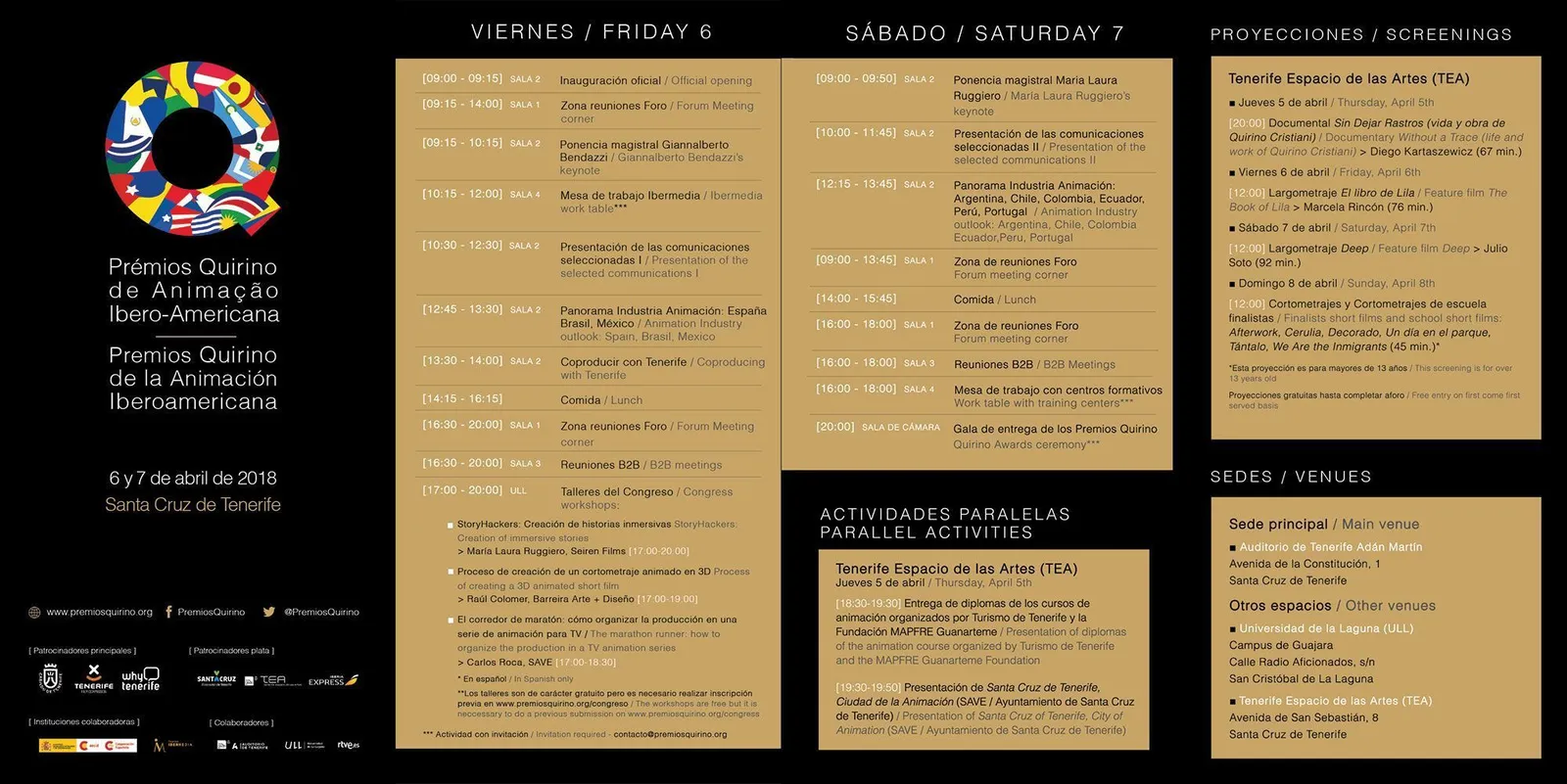
International Congress of Ibero-American Animation
This annual international congress is born out of the necessity of creating a space for debate and reflection about the unstoppable evolution of New Animation Technologies in different media and platforms, and their relation to the world of Education, Art and Communication.
It will be a meeting point for promotion and exhibition, at the service of every teacher or creator that uses animation techniques as artistic, educational or communicational support.
Objectives
To stir up an interdisciplinary exchange between educators, creators, technicians and theorists.
To Reflect and enhance the strategic importance that the intersection between Animation and Technology has and could have in the society of knowledge.
To analyse the relationship that exists between new animation technologies and the educational, communicational and social necessities nowadays.
To pay attention and give support to the animated artistic innovation.
To offer the international community a common forum of reflection, analysis and open debate, dealing with at the same time the philosophical, ethical and social problems that the progress of the digital imagery causes.
Workshops
#StoryHackers: Creation of immersive stories
By Mª Laura Ruggiero | SeirenFilms (Argentina)
A practical workshop of experimentation with stories in virtual reality. #StoryHackers is a nomadic laboratory that explores new narrative boundaries.
Process of creating a 3D animated short film
By Raúl Colomer | Barreira A+D (España)
This masterclass aims to enlighten on the complex procedures of creating a 3D animated short film, from the idea to its final edition with the soundtrack. We will review the most important departments that an animation project involves such as the script, storyboard, character design and environments, modeling, texturing, lighting, fx, render, compositing, etc., emphasizing the professional profiles that are part of these departments so the audience understands how complex and open the production of animation is, where extremes like an artist in the purest sense of the word and a computer engineer passing through a traditional animator can all coexist. For this purpose, the short film project of animation made by the second-year students of the Barreira animation cycle will be used as a “case study”.
The maratón runner: how to organize the production in a TV animation series
By Carlos Roca | Tomavision Studio + SAVE Asociación (España)
In this workshop we will take a tour around the organization of the pipeline for a series of cartoons for television, what tasks intervene, in which order and the importance of the planning and its government to finish the race without dying in the attempt.
Selected congress papers
BLOCK 1 – FRIDAY, APRIL 6th
“Icamiabas, a representação de lendas indígenas e a mulher na animação televisiva brasileira” — Autor: Viktor Danko Perkusich Novaes | Universidade Anhembi Morumbi, Brasil
“La Animación, lenguaje Intuitivo entre Culturas. Recreando historias de Ibero-América para la sabiduría y transformación” — Autor: Inma Carpe Pérez | Universidad Politécnica de Valencia, The Animation Workshop, VIA University College, Dinamarca
“Proyecto MOMO” — Autores: Andrés David Álvarez Hidalgo & Diego Rodríguez López & Ricardo Domínguez Jover | El Caleidoscopio Proyectos de Ciencia y Cultura, España
“A Presença do Desenho no Cinema de Animação Ibero-Americano do Século XX” — Autores: António Costa Valente & Cibele Saque | Universidade de Aveiro, Portugal
“Cleo va a la escuela. Un proyecto didáctico de transformación de una serie de animación televisiva en material didáctico” — Autores: Manuel Area Moreira & Argentina Oliva | Universidad de La Laguna – ULL, España
BLOCK 2 – SATURDAY, APRIL 7th
“68 voces 68 corazones” — Autor: Gabriela Badillo | Hola Combo, México
“Las películas menores de la edad de oro de la animación española. Animadores en el diseño de proyectores de juguete” — Autor: Raúl González-Monaj | Universidad Politécnica de Valencia, España
“Teoria dos Cineastas: Regina Pessoa e a trilogia da infancia” — Autores: Laryssa Moreira Prado & Erika Savernini | Universidade Federal de Juiz de Fora, Brasil
“Argentina & Barcelona: Rodolfo Pastor” — Autores: M. Ángeles López Izquierdo & Miguel Vidal Ortega | Universidad Politécnica de Valencia, España
“Un análisis de la historia de la enseñanza de la animación digital en Quito – Ecuador: El rol de animadores empíricos dentro de la Universidad San Francisco de Quito USFQ” — Autor: Hugo Burgos Y. | Universidad San Francisco de Quito, Ecuador
“Elementos posmodernistas en la filmografía de Juanba Berasategi” — Autor: Maitane Junguitu Dronda | Universidad del País Vasco – UPV/EHU, España